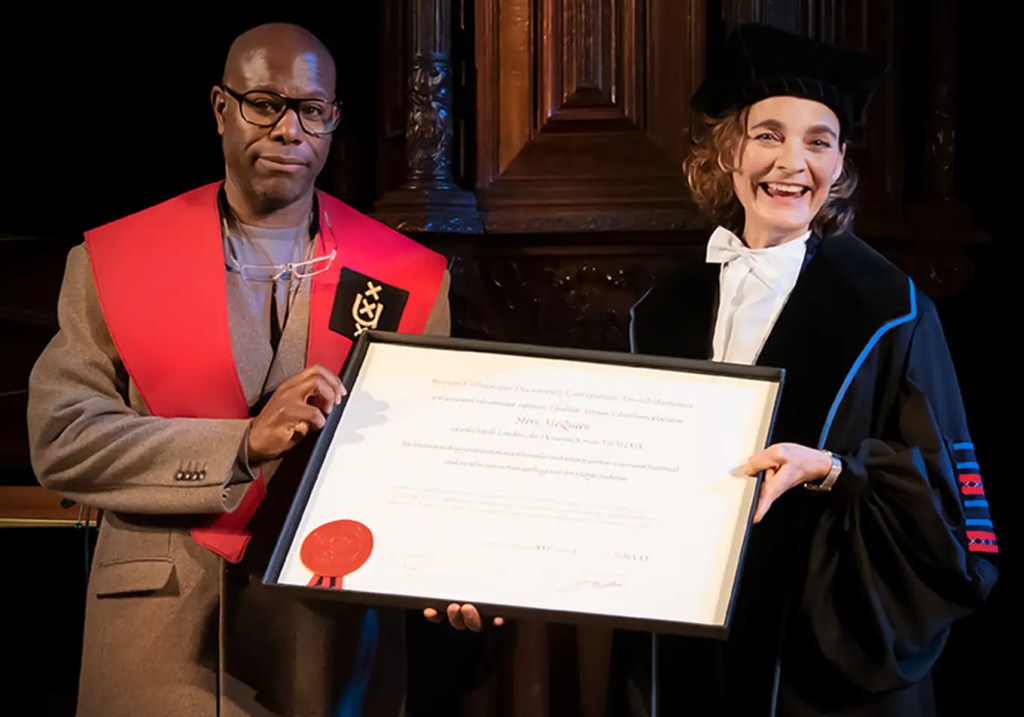
Steve McQueen and Bianca Stigter received honorary doctorates for the great social and historical value of their work, in particular their documentary Occupied City. The honorary doctorates were awarded during the celebration of the Dies Natalis of the UvA on Thursday, 16 January 2025. Honorary supervisor is Prof. Patricia Pisters, professor of Film Studies at the Faculty of Humanities. See for more information and links to the recorded live stream here. Read the laudation for Bianca Stigter here. The laudation for Steve McQueen can be found here.
Steve McQueen is a filmmaker, screenwriter and visual artist. Bianca Stigter is a historian, journalist, writer and filmmaker. McQueen has made various artworks using film and installations, many of which have been acquired by leading museums around the world. In 2008, he wrote and directed his first feature film Hunger, and in 2013 his film 12 Years A Slave was released, later winning three Oscars. Stigter, who studied History at the UvA, writes for NRC Handelsblad, among other publications. She was associated with 12 Years a Slave as a producer. She is the maker of the documentary Three Minutes, A Lengthening (2021), which was shown at almost all of the major film festivals (Venice, Sundance, Toronto). In that film essay, Stigter examines a fragment of a family film shot in 1938 in a Jewish community in Poland, to reflect on the Holocaust, time and what film can mean. In 2005, her book Occupied City: Map of Amsterdam 1940-1945 was published. That was followed by three collections of essays about art and history. In 2019, she published Atlas of an Occupied City. Amsterdam 1940-1945. Based on this book, McQueen and Stigter made the 4.5-hour documentary Occupied City together. The film recently won three Golden Calves at the Netherlands Film Festival: Best Long Documentary, Best Photography and Best Editing.
Historical sources and events form the basis for much of McQueen’s work. He thereby gives new meaning to these sources and to material heritage, such as urban locations where historical violence has taken place. His work highlights, among other things, the continuing consequences of slavery and racism in various contemporary contexts. With her historical research, particularly on Amsterdam during the Second World War, Stigter offers an important popular scientific contribution to the debates and culture around remembrance. In Three Minutes and Occupied City, she shows how many histories are hidden in seemingly unimportant archive material. By doing so, she also sheds new light on historical source material and on film and film history.
‘McQueen and Stigter have each earned their own stripes. They bring major social issues and political and historical themes to the attention of a large audience,’ says honorary supervisor Patricia Pisters. ‘Their documentary Occupied City has a double historical value: Amsterdam’s past in the Second World War is history, but the present that is discussed is also already becoming history. In the documentary we see major events and the impact they have on Amsterdam: the outbreak of the corona pandemic, the lockdowns and protests, the apologies for slavery, climate activism, Black Lives Matter demonstrations, the war in Ukraine. The combination in which two historical lines come together makes the film unique and monumental.’
 Patricia Pisters